
Our Breeding Programme
Breeding a new rose is a slow and thoughtful process, blending creativity with careful observation. From the first pollination to a rose ready to be introduced, the journey takes twelve years. Each step requires patience, skill, and an eye for promise. Built on decades of experience, our breeding programme is one of the most extensive in the world.
i. Selecting Parents
Every rose begins with a pairing. We choose two existing varieties, known as the parents, whose qualities we hope to combine. This choice is guided by experience and intuition. We look for strength, beauty, fragrance, colour, and health, always seeking the potential for something truly special.

ii. Hybridisation
Once selected, pollen is gently taken from one parent and transferred by hand to the other. While bees perform this task naturally, here it is carried out with precision. Each year, many thousands of these pollinations take place.
In time, the pollinated flower forms a rose hip. Inside are seeds, each one unique. Like siblings in a family, no two seedlings will ever be exactly the same.


iii. Hip Harvesting
By late autumn, the hips are ready to harvest. Seeds are carefully removed, cleaned, and stored in cool conditions over winter. In January, hundreds of thousands are sown in our greenhouses.
Weeks later, the first seedlings appear, delicate and full of possibility. Soon, they begin to bloom.

- "There is nothing more exciting than having 350,000 seedlings growing that no one has ever seen before."
David C. H. Austin OBE


iv. Seedling Evaluation & Selection
In spring, each young plant is assessed. We look for healthy growth, attractive flowers, and good form. Only a small number show the qualities needed to continue. These selected seedlings move outdoors for further trials.

v. Field Trials
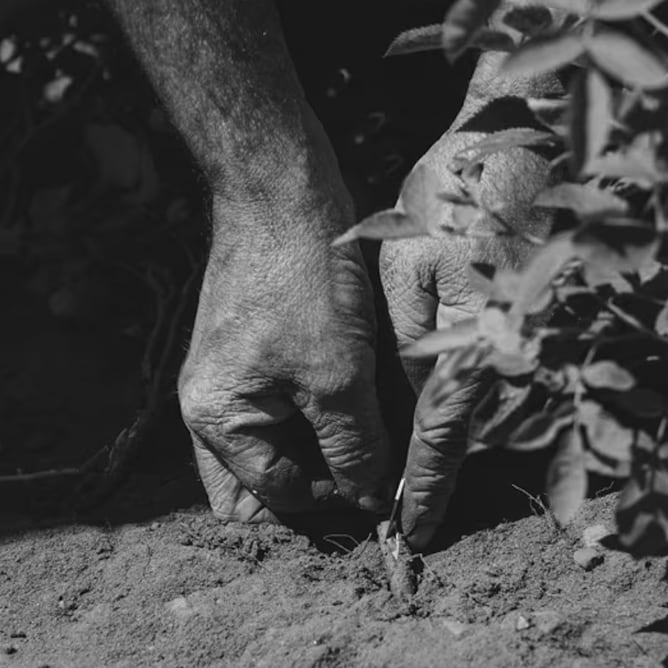
In open ground, the roses are observed over several years. We study how they grow, how they flower, how they cope with weather and disease. With each passing season, selections become more refined. Numbers gradually reduce.

vi. Final Selection
The remaining candidates are grown in larger numbers and compared closely. Here, subtle differences matter. Consistency, beauty, strength, and reliability all play a part.
From thousands of beginnings, one or two roses are chosen.
After twelve years, a new rose is ready to meet the world.